
5 Best Insoles for High Arches in the UK (2026)
Published July 22, 2026 · Updated July 22, 2026
The best insoles for high arches should meet the arch without creating a hard pressure point, cushion the heel and forefoot, steady the rearfoot, and still fit the shoes you wear. We ranked five options available in the UK for arch contact, pressure distribution, stability, footwear fit and annual cost.
Skip to top picks ↓ · 8 min read
Our process: We compared published arch height, shell firmness, heel stability, cushioning, footwear volume, regional price and replacement guidance. SoleBrace makes WorkFit, so that relationship is disclosed. WorkFit ranks first overall for the strongest balance across those criteria; specialist maximum-height shells remain better for some very high arches.
KEY TAKEAWAYS
- High arches need contact plus cushioning. The arch should feel supported while the heel and ball of the foot receive enough impact protection.
- The highest insert is not automatically the best. Arch length, rigidity and footwear depth decide whether a profile feels supportive or painfully intrusive.
- Watch the outside edge. High arches can load the heel, forefoot and lateral edge more heavily, so rearfoot stability matters.
- Progressive or one-sided changes need assessment. An insole cannot diagnose the cause of a changing high arch.
Contents
- Quick Picks: 5 Best Insoles for High Arches
- Spenco Total Support Original
- Aetrex L2300 Premium Memory Foam
- PowerStep Pinnacle High
- Superfeet All-Purpose Support High Arch
- WorkFit by SoleBrace
- Annual cost comparison
- What high arches change underfoot
- How to choose a high-arch insole
- Head-to-head comparison
- FAQ
Quick Picks: Best Insoles for High Arches in the UK (Ranked)
- Comfortable step down from aggressive high arches
- Metatarsal support helps spread forefoot load
- Deep heel cup improves stability
- Broad everyday-footwear fit
- Plush forefoot and heel cushioning
- Medium-high arch suits less extreme high arches
- Polyurethane base improves shape retention
- Deep heel cup adds stability
- Purpose-built high arch profile
- More cushioning than a hard shell alone
- Deep heel cradle improves stability
- Fits walking, work and casual shoes with removable liners
- High arch profile is explicit, not implied
- Firm stabiliser cap resists flattening
- Deep heel cup adds rearfoot stability
- Official US and UK availability
- Low-profile fit for work and safety footwear
- Rebound Pods add heel and forefoot cushioning
- Breathable Honeycomb Base manages enclosed-shoe heat
- 30-day trial
Spenco Total Support Original

A medium arch with a deep heel cup, metatarsal support and multi-density cushioning.
The fit decision matters as much as the material. A high-arch insert should make broad, comfortable contact beneath the arch without creating a sharp pressure point or lifting the heel out of the shoe.
What Works
- Comfortable step down from aggressive high arches
- Metatarsal support helps spread forefoot load
- Deep heel cup improves stability
- Broad everyday-footwear fit
Trade-offs
- Not a true maximum-height arch
- Metatarsal pad can feel unfamiliar
- Can crowd slim shoes
Aetrex L2300 Premium Memory Foam

A medium-high profile with a cupped heel and extra forefoot cushioning for pressure-sensitive feet.
The fit decision matters as much as the material. A high-arch insert should make broad, comfortable contact beneath the arch without creating a sharp pressure point or lifting the heel out of the shoe.
What Works
- Plush forefoot and heel cushioning
- Medium-high arch suits less extreme high arches
- Polyurethane base improves shape retention
- Deep heel cup adds stability
Trade-offs
- Thicker than low-profile inserts
- Premium price
- May not contact a very high rigid arch
PowerStep Pinnacle High
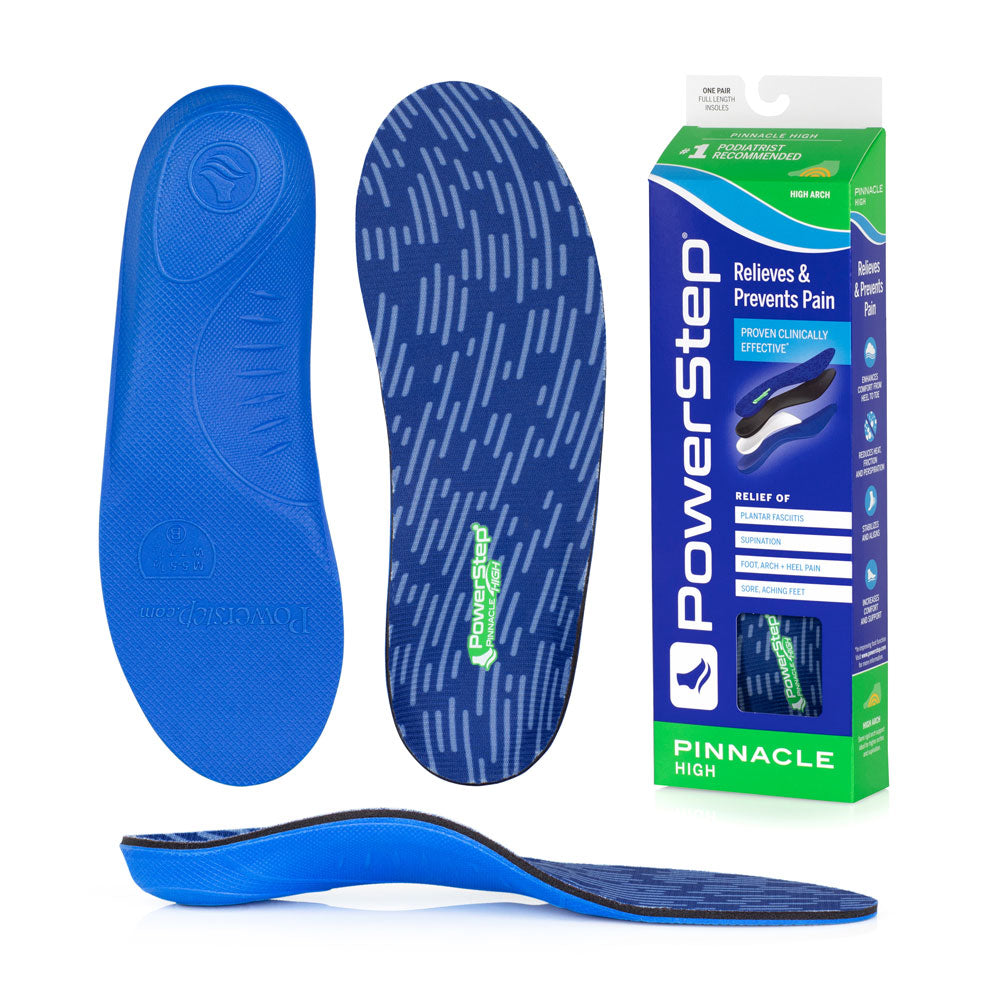
A firm-but-flexible high arch shell with a deep heel cradle and dual-layer cushioning.
The fit decision matters as much as the material. A high-arch insert should make broad, comfortable contact beneath the arch without creating a sharp pressure point or lifting the heel out of the shoe.
What Works
- Purpose-built high arch profile
- More cushioning than a hard shell alone
- Deep heel cradle improves stability
- Fits walking, work and casual shoes with removable liners
Trade-offs
- Full-length profile needs space
- No trimming on most listed sizes
- UK pricing and stock vary by retailer
Superfeet All-Purpose Support High Arch

A firm, genuinely high-profile shell for roomy shoes and work footwear with removable liners.
The fit decision matters as much as the material. A high-arch insert should make broad, comfortable contact beneath the arch without creating a sharp pressure point or lifting the heel out of the shoe.
What Works
- High arch profile is explicit, not implied
- Firm stabiliser cap resists flattening
- Deep heel cup adds rearfoot stability
- Official US and UK availability
Trade-offs
- Maximum-thickness design
- Can feel too aggressive for moderate arches
- Needs roomy footwear with a removable liner

A lower-volume work insert with Orthopaedic Arch Support, Rebound Pods and a Breathable Honeycomb Base.
The fit decision matters as much as the material. A high-arch insert should make broad, comfortable contact beneath the arch without creating a sharp pressure point or lifting the heel out of the shoe.
What Works
- Low-profile fit for work and safety footwear
- Rebound Pods add heel and forefoot cushioning
- Breathable Honeycomb Base manages enclosed-shoe heat
- 30-day trial
Trade-offs
- Not the highest arch profile in this ranking
- Best for moderate-to-high arches, not rigid cavus deformity
- Online-only purchase
Annual Cost Comparison
Price per pair is only half the calculation. These estimates use published or typical replacement windows and should be shortened when cushioning stays compressed or the shell loses shape.
| Insole | Price (GBP) | Expected replacement | Annual Cost (GBP) |
|---|---|---|---|
| Spenco Total Support Original | about £38 GBP | 6–12 months | £38–£76 |
| Aetrex L2300 Premium Memory Foam | about £50.99 GBP | 6–12 months | £68–£102 |
| PowerStep Pinnacle High | about £55 GBP | about 6 months | about £110 |
| Superfeet All-Purpose Support High Arch | £40 GBP | 6–8 months | £60–£80 |
| WorkFit | £32 GBP | 8–12 months | £32–£48 |
Scroll for more →
What High Arches Change Underfoot
High arches, also called pes cavus, make less midfoot contact with the ground. British Orthopaedic Foot & Ankle Society explains that pronounced high arches can increase loading through the heel, ball of the foot and outer edge, and may be associated with instability.
The aim of an insole is not to force the arch flat. It is to increase comfortable contact and redistribute pressure. A randomised trial indexed by PubMed found better pain and function outcomes from custom orthoses than sham inserts in adults with painful cavus feet, while later analysis linked benefit to redistribution of plantar pressure rather than simple softness.
Limited midfoot contact
Less surface area through the arch can concentrate force under the heel and forefoot.
Outer-edge loading
Some high-arched feet remain more supinated, increasing pressure along the lateral foot.
Stability demands
A deep heel cup and secure shoe fit can matter as much as the height of the arch.
Pressure redistribution
The useful insert spreads load without introducing a sharp new contact point.
How to Choose the Right Insole for High Arches
1. Match arch height and length
The support should follow your arch from heel toward forefoot. A tall lump in the wrong position is a poor fit even when the advertised height is correct.
2. Add heel and forefoot cushioning
High arches often concentrate pressure away from the midfoot. Look for cushioning at the heel and ball of the foot rather than foam placed only beneath the arch.
3. Check rearfoot stability
A shaped heel cup can help the heel sit consistently, but it should not pinch or tilt the foot painfully.
4. Respect footwear volume
Maximum-height inserts need roomy shoes with removable liners. In safety footwear, confirm toe clearance and heel hold before a full shift.
5. Know when OTC is not enough
See a podiatrist or doctor for progressive, one-sided or painful deformity, recurring ankle instability, weakness or numbness. Those signs need assessment rather than a stronger retail insert.
Head-to-Head Comparison
Scores reflect suitability for the high-arch purchase intent, not a claim that one profile fits every foot.
| Criteria | Spenco | Aetrex | PowerStep | Superfeet | WorkFit |
|---|---|---|---|---|---|
| High-arch match | 8.5 | 9.5 | 9.0 | 8.0 | 6.5 |
| Cushioning | 9.0 | 6.5 | 9.0 | 9.5 | 8.0 |
| Roomy-shoe fit | 8.0 | 9.0 | 8.5 | 8.0 | 8.0 |
| Low-volume fit | 9.0 | 4.5 | 6.0 | 5.0 | 6.5 |
| Value | 9.0 | 8.0 | 8.0 | 6.5 | 7.5 |
FAQ: Insoles for High Arches
What are the best insoles for high arches in the UK?
WorkFit ranks first overall because it balances structured arch contact, heel and forefoot cushioning, work-footwear fit, breathability and annual value. Superfeet All-Purpose Support High Arch is the specialist alternative for people whose main priority is a maximum-height firm shell.
Should high arches use soft or firm insoles?
High arches usually need both contact and cushioning. A supportive shell helps meet the arch, while heel and forefoot cushioning help spread load across areas that otherwise take more pressure.
How can I tell whether my arches are high?
A high arch stays visibly raised when you stand and often leaves little midfoot contact in a footprint. A footprint is only a rough screen; progressive, one-sided or painful changes need assessment by a podiatrist or doctor.
Can high arch insoles help with supination?
They may improve contact and stability for some people, but high arches and supination are not identical in every foot. If you repeatedly roll an ankle, wear one shoe edge rapidly or feel unstable, get the underlying mechanics assessed.
Do high arch insoles need a break-in period?
A mild sense of new contact can settle over several short wears. Sharp pressure, numbness, increasing pain or a heel that lifts out of the shoe means the profile or footwear fit is wrong.
Will high arch insoles fit work boots?
Yes, when the factory liner is removable and the replacement does not steal toe room. Maximum-thickness models need roomy boots; lower-volume options are safer in tight safety footwear.
When should high arches be checked professionally?
Seek assessment when the arch is changing, one foot differs markedly from the other, weakness or numbness is present, or ankle instability and pain persist. Very high or progressive arches can have causes that an over-the-counter insole cannot diagnose.
Related Guides
UK Sources
These clinical and product references support the foot-shape, pressure-distribution and fit guidance used in this comparison.
Choose contact, cushioning and fit together
A high arch needs more than the tallest insert on the shelf. Start with arch contact, then confirm heel and forefoot cushioning, stability and enough room inside your footwear.
View WorkFit Insoles