 Trending in the US
It Starts In Your Feet. It Decides What Your Future Looks Like.
A podiatrist on the research that predicts how long a man will live, and the piece of equipment quietly deciding it for anyone who works on hard floors.

Ask any worker who's been on hard floors for twenty years where their pain is, and almost none of them will say their feet. They'll tell you about their knees. Their lower back. The hip that seizes on a cold morning. By the time it's loud enough to talk about, the feet have usually gone quiet, which is exactly why so few men catch it in time.
Dr. Michael Torres has spent twenty years watching that pattern repeat in men in the trades, factory workers, miners and warehouse crews. He often describes two men who started the same and finished differently. Same age, same trade, same thirty years on the same kind of floor. Neither was unlucky, he says, and neither did anything wrong at work. What separated them was that one found out what was happening under his feet while there was still something left to protect.
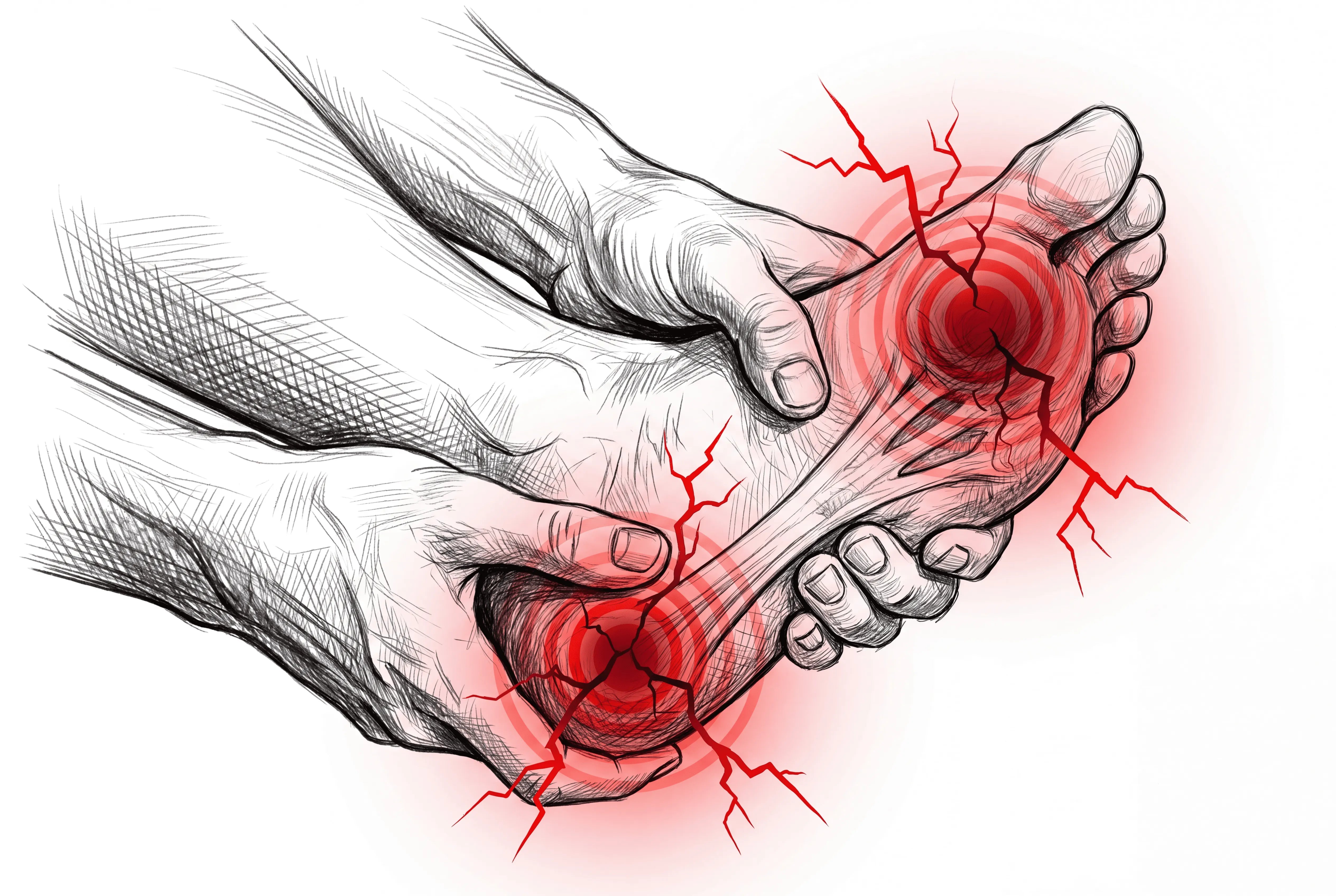
Why This Is Personal For Him
Torres didn't choose this field out of a textbook. He chose it because of his grandfather.
His grandfather laid concrete for thirty years, and he was good at it. But by the time he hit his sixties he could barely get down on the floor to play with his own grandkids. He'd wave them off, say his back was giving him trouble, and stay in his chair.
By the time he finally saw someone about it, it wasn't just his feet anymore. It was his knees, his hips, his whole back. Nobody caught it early enough to stop it.
— Dr. Michael Torres
Torres was one of those grandkids. He grew up watching a strong, capable man get boxed in by his own body, giving up one thing at a time until there wasn't much left he could do.
And the part he understands now, which nobody understood then, is what came after. His grandfather didn't only lose the floor with the grandkids. He lost the walk to the store, then the garden, then most of the reasons to leave the house at all. What happens to a man once he stops moving is rarely written down as a foot problem.
"I've spent my whole career," Torres says, "trying to be the person who catches it early. For someone else's grandfather."
The Research That Changed How He Practices
For years Torres assumed the patients who ended up housebound in their later years had simply drawn a bad hand. Then he started reading the longevity research.
There is a test that predicts how long a person will live about as accurately as anything in their blood work. It isn't a scan. It isn't a cholesterol number. It's how fast they walk across a room.
Researchers pooled the records of more than thirty-four thousand people and found ordinary walking speed predicted survival roughly as well as a full medical workup: age, blood pressure, weight, smoking history, chronic conditions and hospital record, all combined. A separate study of nearly fifty thousand adults found the people who walked the most had around forty to fifty percent lower risk of dying early than those who walked the least.
Walking speed measures far more than fitness. It's the heart, the lungs, the circulation, the nerves and the muscles all reporting in at once.
"If walking matters that much, what takes it away first from a man who's been on his feet his whole working life? It starts with a thin layer of tissue under his heels and the balls of his feet, and it usually starts twenty years before he feels anything at all."
How A Foot Problem Becomes A Back Problem
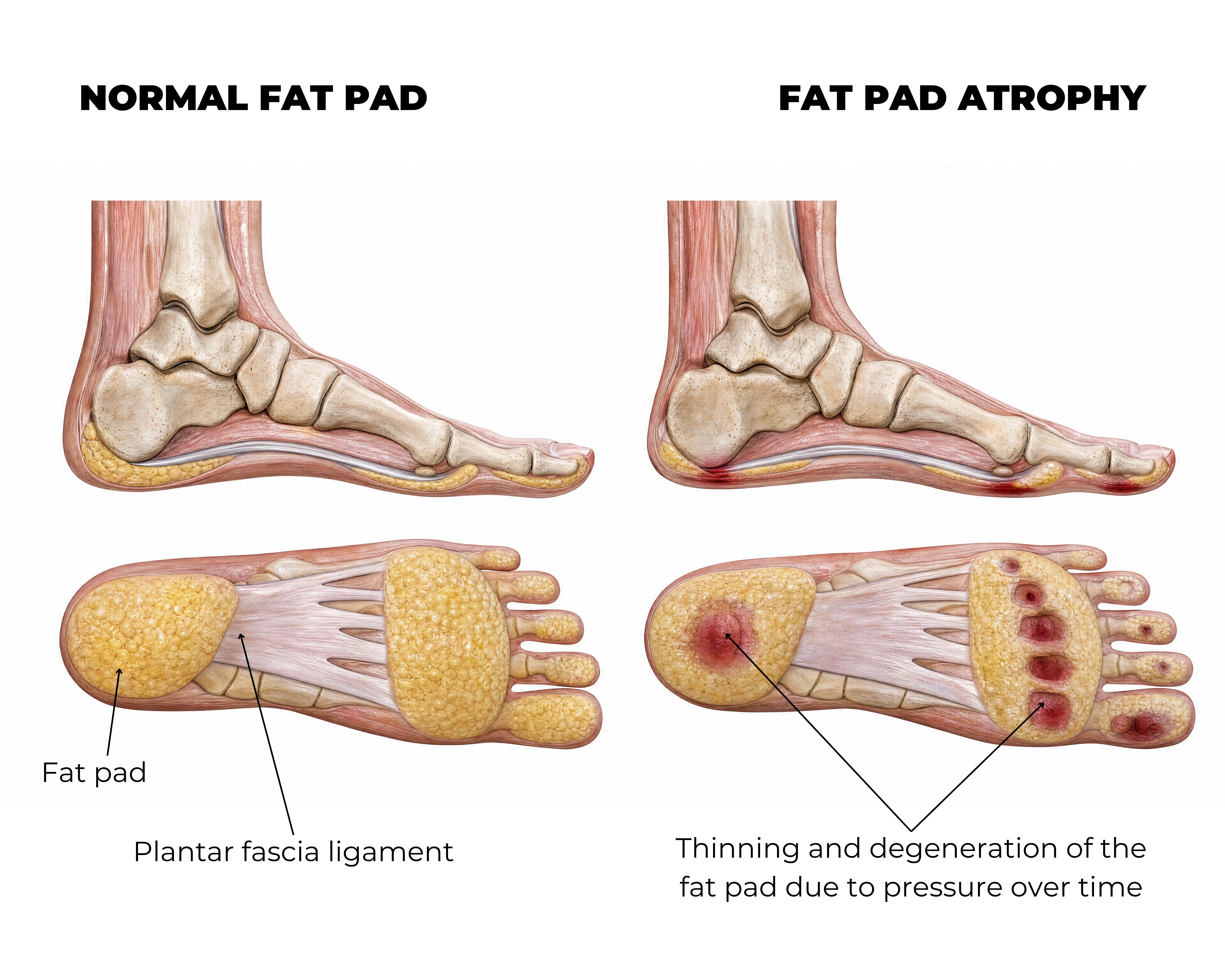
Under your heels and under the balls of your feet sit natural cushions called the fat pads. They're the shock absorbers your whole skeleton rests on, taking the impact of every step so the joints above don't have to.
The problem is what sits between those pads and the floor. The insole that comes standard in a work boot, any brand, at any price, is built to meet a manufacturing standard. It's a placeholder, never engineered to survive ten hours a day on a hard surface. So it compresses, a fraction more each step than it springs back, and within a couple of weeks it stops springing back at all. Torres calls that Collapse Fatigue.
From that day on, the fat pads take the full load. Alone. Every step, every shift, for years. They thin out. That's Fat Pad Atrophy.
The part he can't get patients to hear early enough
Almost everything else in the body repairs itself. Skin closes. Bone knits. Muscle rebuilds. The fat pads under your feet don't. Once that tissue is gone, there is no procedure, no injection and no insole on earth that puts it back. The only thing anyone can do about Fat Pad Atrophy is stop it before it happens.
From there it climbs. The arch starts covering for cushioning that isn't there, which is when it tips into Plantar Fasciitis, the tearing pain through the heel and arch on the first few steps out of bed. Then a man changes how he walks without deciding to, and the ankles absorb what the feet no longer can. Then the knees. Then the hips. Then the lower back, holding up a chain that's been failing from the ground up the whole time.
"By the time someone comes to me about their back," Torres says, "the real problem usually started in their boots two years earlier. They just never felt it happen." Every stage feels like a separate problem with its own cause, so men treat each one on its own and the thing driving all of it never gets touched.
Where You Are On This Line
Almost every man he sees is somewhere on the same line.
Nothing. The insole is already failing, but the fat pads are thick enough to cover for it.
The feet ache at the end of a shift and you chalk it up to a long week.
The ache stops clearing overnight and the first few steps in the morning start to hurt. This is where the damage becomes permanent, and the last point where stopping it changes anything.
It isn't a foot problem anymore. It's the knees, the hips, the back.
"Most of the men who sit in my clinic arrive at the third stage," he says, "convinced they're at the second."
Check It Yourself Tonight
Torres tells patients not to take his word for it. Tonight, pull the insole out of the boot you've worn all week and press your thumb hard into the heel section, then the section under the ball of the foot.
If it gives way and stays down, it stopped protecting you months ago. And every shift since, that load has been going somewhere else.
Why Nothing You've Tried Has Held
New boots, gel inserts, custom orthotics, anti-inflammatories before a shift. Torres says every one of those is a reasonable attempt, and not one of them touches the part that's actually failing.
Past a certain point the conversation in his clinic changes. It stops being about insoles and starts being about cortisone shots, fascia release, knee replacements. Those are repairs, and every one of them narrows what your later years are allowed to look like.
What He Actually Tells His Patients To Do
"This is what I recommend to the people who come to see me," Torres says. "And it's what I'd give anything to have been able to tell my grandfather, decades before it was too late to matter."
The insole he points them to is called WorkFit™, and the reason he trusts it is that it isn't one flat piece designed to fail. It's built in four separate zones, each doing a different job.
Rebound Pods under the heel and the forefoot, the two places your fat pads take the impact, made to spring back after every step instead of compressing down and staying there.
A memory foam core underneath, which recovers its shape rather than packing flat.
Orthopedic arch support, holding your structure under load so the plantar fascia isn't left covering for cushioning that isn't there.
A breathable honeycomb base, spreading the load so no single point takes all of it, hour after hour.
You keep the boots you've got. You change what's inside them.
Torres tested WorkFit™ with 150 workers on hard floors, all already living with chronic foot pain. At ninety days, 127 reported significant improvement, and the insoles themselves had held ninety-six percent of their original cushioning. He wears a pair in his own work shoes.
The Years You've Already Paid For
None of this, Torres is careful to say, is only about the pain you feel today. You spend thirty or forty years trading your body for a paycheck because of what's waiting at the end. The hiking with your wife. The fishing. The grandchildren. Mornings that finally belong to you.
The cruelest version of losing it isn't being unwell. It's being well enough to want all of it and not well enough to do any of it. It's being the one in the chair at the barbecue while everyone else is out in the yard.
I'm not going to promise anyone a miracle. Tired at the end of a day the way anyone would be, but not wrecked by it. Still going for walks with your wife. Still walking the dog. Still getting down on the floor with the grandchildren, and more to the point, still getting back up.
— Dr. Michael Torres
If there's damage there already, you can't undo it. What you can do is stop adding to it, starting on your next shift.
CLICK HERE To Get SoleBrace® WorkFit™ Insoles
GET YOUR WORKFIT INSOLESWhat Workers Are Saying
